
Non-Destructive Concrete Lifting
Concrete Slab Leveling in Olympia, WA
Restore uneven sunken concrete in minutes without expensive slab replacement.
Precision Polyurethane Foam Concrete Lifting
Sunken, tilted concrete slabs along driveways, entry walkways, pool decks, and garage floors present unsightly tripping hazards and redirect rainwater directly toward foundation walls. Rather than jackhammering and pouring new concrete, our polyurethane foam injection process drills penny-sized holes and injects expanding structural polymers beneath the slab. The expanding foam consolidates weak sub-base soil and gently lifts the concrete back to flush alignment.
Service Areas & Local Coverage
Contractors in our network are registered, bonded and insured in Washington, and provide concrete slab leveling across Olympia and surrounding communities. View local coverage & municipal permit guidelines →

Why choose us for Concrete Slab Leveling?
Minimal Disruption
Dime-sized injection holes are patched seamlessly; slabs are ready for full vehicle traffic in just 15 minutes.
Waterproof & Hydrophobic
Polyurethane foam will never wash away or degrade when exposed to Olympia's high rainfall and groundwater flows.
Related Guides & Articles
Concrete Slab Leveling vs Replacement: Polyurethane Foam Lifting in Thurston County
Discover why high-density polyurethane foam injection (polyjacking) is replacing traditional mudjacking and costly concrete replacement.
Read guide →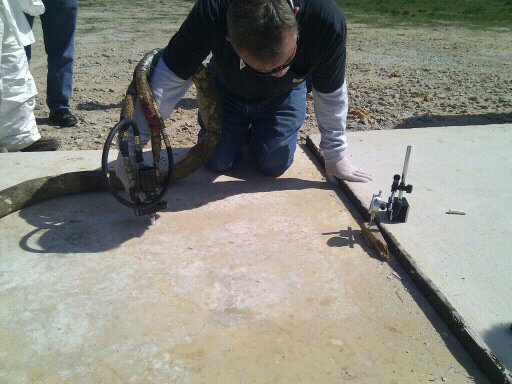
When lifting works — and when it doesn't
Polyurethane foam lifting (polyjacking) raises a settled slab by injecting expanding structural foam through small ports drilled in the concrete. It is fast, clean, and far cheaper than replacement — but only where the slab itself is still sound.
Good candidates
- Driveways, walkways, patios and garage floors that have settled as intact pieces
- Trip hazards at joints between otherwise sound panels
- Slabs that have dropped because fill beneath them consolidated or washed out
- Pool decks and steps that have pulled away from the structure
Poor candidates
- Concrete that is extensively cracked, spalling or crumbling — lifting a failing slab just relocates the failure
- Slabs broken into many small fragments, which will not move as a unit
- Thin or unreinforced concrete that will crack under point lifting
- Situations where the underlying cause — an active leak, an eroding downspout discharge — hasn't been addressed first
If a slab is structurally spent, lifting it is money spent twice. An honest assessment sometimes concludes replacement is the cheaper answer over any reasonable horizon.
Foam versus mudjacking
Traditional mudjacking pumps a cement slurry under the slab. It still has a place, but polyurethane has largely displaced it for residential work in this region for a few concrete reasons:
- Weight. Slurry is heavy — it adds load to the very soil that already failed. Foam weighs a small fraction of that.
- Hole size. Foam ports are typically around 5/8 inch; mudjacking holes are commonly 1–2 inches and far more visible afterwards.
- Cure time. Foam reaches working strength in minutes, so a driveway is usually drivable the same day. Slurry needs longer.
- Water sensitivity. Cementitious slurry can wash out over time where water moves under a slab; closed-cell foam does not absorb water.
Mudjacking can still be the better value on large, heavy commercial slabs or where the void is very large. For a typical residential driveway here, foam usually wins.
Fix the cause, or it will settle again
This is the step most often skipped. Slabs in Thurston County rarely settle for no reason, and the reason is almost always water moving soil.
The usual culprits: downspouts discharging at the slab edge instead of being piped away, failed or missing gutters, irrigation aimed at the foundation, a leaking service line, or poorly compacted backfill in a trench that was cut through the driveway years ago. On sloped lots, sheet flow across a driveway during a heavy November storm can undermine an edge remarkably quickly.
Lifting the slab without redirecting the water buys a few seasons. Any contractor who does not walk the drainage with you before quoting is quoting half a job.
What to expect on the day
Most residential lifts are a few hours, not days:
- Ports are drilled in a pattern matched to the void and the slab geometry
- Foam is injected in controlled stages while the lift is monitored with a level or laser
- Adjacent panels are watched so the slab comes up evenly rather than tilting
- Ports are patched with cement grout — visible on close inspection, but far less so than mudjacking holes
- The surface is generally ready for foot traffic almost immediately and vehicles the same day
Reasonable expectations: lifting closes trip hazards and restores drainage fall. It will not make old concrete look new, and existing cracks remain existing cracks — they may open or close slightly as the panel moves.
Get an Exact Quote for Your Project
Speak with our local specialists for honest pricing, clear timelines, and a written scope before work begins.
- Laser Level Elevation Survey: Precise floor slope mapping and structural deflection analysis.
- Driven to Verified Bearing: Piers are advanced to measured refusal, not to a guessed depth.
- Warranty Terms Up Front: Ask any contractor we refer for their written warranty and what transfers at resale before you sign.
Prefer to speak with an estimator? Call (360) 209-7814.
Request a Free Quote
Fast pricing with zero pressure.
Request a Concrete Slab Leveling estimate
Request a slab leveling estimate.
Free, no-obligation estimate.